L'HISTOIRE DE BEUIL
Perché au sommet d'un piton rocheux à la sortie des spectaculaires Gorges du Cians, Beuil était au temps des Romains une forteresse qui contrôlait le passage des armées et constituait une étape sur la route romaine qui faisait communiquer, à travers les Alpes, la Gaule cisalpine et les régions transalpines. Les premières tribus ligures qui occupèrent Castrum Boliacum, ou Boleo, ou Boglio, furent les Velaunes, peuple qui vivait d'élevage, de chasse et de pêche.
Historiquement, à partir du XIIIème siècle, Beuil fit partie du Comté de Provence, dont l'histoire complexe fut marquée par d'innombrables invasions, celles des Francs, des Lombards et des Sarrasins en particulier, entre l'an 500 et l'an 800, année où Charlemagne vint à Nice pour y établir un évêché et confirmer son neveu Hugues de Grimaldi dans son titre de Comte d'Antibes, réorganisant du même coup l'administration du Comté de Nice. Vers la fin du Xème siècle, Othon, empereur du Saint Empire Romain Germanique, fit don du rocher de Monaco aux Grimaldis pour l'avoir aidé dans le conflit qui l'opposait à la République de Gênes. Au même moment, le Comte de Provence, avec l'aide de ses vassaux, mit les Sarrasins en déroute définitivement. En 1230, le Comté de Nice fut annexé par la Provence.
Une histoire très mouvementée…
Beuil connut le tournant d'une histoire fondée sur l'affirmation de soi au moment du règne de Guillaume Rostang (1285-1315), homme brutal et belliqueux, lorsque celui-ci décida de remettre en vigueur le droit de cuissage. Une révolte de ses sujets s'ensuivit aussitôt et il mourut sous les coups de hache. Afin d'empêcher toute répression, les habitants de Beuil demandèrent la protection du puissant Andarro de Grimaldi, l'oncle de René de Grimaldi, alors seigneur de Monaco. Andarro de Grimaldi accepta et se maria avec Astruge Balb, la fille de Guillaume Rostang, qui régna de 1315 à 1333. C'est ainsi que les Grimaldis prirent le titre de seigneurs de Beuil, titre qu'ils gardèrent jusque 1621 lorsque le Duc de Savoie annexa Beuil au Comté de Nice.
A la mort d'Andarro, Robert d'Anjou, Comte de Provence et Roi de Naples, qui avait perdu son fils unique, nomma sa fille Jeanne son héritière et Comtesse de Provence. Les Grimaldis s'assurèrent sa protection et elle leur reconnut la possession du fief de Beuil , les autorisant à construire et à fortifier un château en Mai 1365. Les territoires de Beuil formaient alors un triangle, avec pour sommet le Mont Mounier et pour côtés la Tinée à l'est, la vallée du Cians à l'ouest et le Var au sud.
Entre temps, après la mort de son mari, le roi de Hongrie par strangulation (apparemment une habitude en ce temps-là comme on le verra), la reine Jeanne refusa d'épouser Charles Duras, successeur de son mari sur le trône de Hongrie, ce qui ne manqua pas d'ajouter à la complexité inextricable de la situation. Car c'est à ce moment-là qu'éclata le problème de l'élection d'un nouveau pape. Deux factions s'opposaient sans pouvoir s'entendre, ce qui eut pour conséquence l'élection de deux papes, l'un qui résida en Avignon, Clément VII, l'autre à Rome, Urbain VI. Ce dernier reçut le soutien de Charles Duras alors que Clément VII était soutenu par la Reine Jeanne. Charles Duras attaqua cette dernière, la fit prisonnière, l'enferma et la fit étrangler.
Les Grimaldis se déclarèrent en faveur de Charles Duras et, selon une stratégie dont le but était de contrer les visées de Louis d'Anjou qui venait d'envahir la Provence et menaçait le Comté de Nice, ils demandèrent la protection d'Amédée VII de Savoie, alors Vicaire Général d'Urbain VI. Amédée VII donna à Beuil les territoires de Roubion, Roure, Péone, Ilonse, Pierlas, Thiéry, Bairols, Touët et Rigaud, que Beuil garda, perdit ou récupéra au gré des trahisons et des allégeances de ses seigneurs tout au long de ces années-là.
Le 2 Août 1388, Jean de Grimaldi, dont le règne fut le plus long (1368-1445) rejoignit d'autres seigneurs pour signer l'Acte de Dédition, par lequel Nice prêtait allégeance au Duc de Savoie. Ce faisant, les Grimaldis de Beuil mettaient leurs fiefs et propriétés diverses sous la protection du Comté de Nice, donc du Duc de Savoie.
Les quelque cent ans qui suivirent furent des années de complots, de meurtres, de conspirations, d'intrigues et de rivalités de toutes sortes. Amédée VII mourut et son fils, âgé de huit ans, lui succéda. Les villages de Guillaume et d'Utelle en profitèrent pour se rebeller et demander la protection de Marie d'Aragon. Jean de Grimaldi perdit ses fiefs de Villars et tenta de dénoncer l'accord de 1388 mais revint dans le giron de la Savoie. En 1416, Nice reçut le statut de Duché et Beuil passa alors alternativement des mains du seigneur de Nice à celles des Barons de Beuil, au gré des allégeances. Après le règne de Pierre de Grimaldi (1445-1473), dont la révolte contre le Duc de Savoie fut écrasée, son fils Jacques (1473-1490) reçut le titre de gouverneur de Nice. Son fils Georges (1490-1506) lui succéda, mais écrasant ses sujets sous le poids des taxes et de la dîme, il eut la gorge tranchée par son barbier en 1508. Honoré I, son successeur, régna 30 ans, résistant aux trahisons multiples, y compris celle de son fils qui réussit à persuader les habitants de Puget de piller les territoires appartenant à Beuil. Quand il mourut, René, son fils, lui succéda et régna cinq ans mais fut assassiné par son domestique à Entrevaux en 1542, tandis que son frère Jean Baptiste d'Ascros s'allia au Roi de France pour aider les Turcs dans leur siège de Nice. Honoré II Grimaldi (1542-1591) lui succéda, homme fidèle à la Maison de Savoie, seigneur sage et avisé, très habile en politique. Sous son règne en Mai 1581, Beuil passa du statut de baronnie à celui de comté. Ce fut une période de calme, de paix et de prospérité . A ses possessions, Honoré II ajouta quelques autres fiefs et les revenus des terres de Massoins, Tournefort, Marie, Sauze, Villars, Malaussène et de quelques autres villages. En 1591, son fils Annibal lui succéda avec la célèbre devise : « Sono il comte di Boglio/ Facia quello que voglio » (« Je suis comte de Beuil et fais ce que je veux ». Et de fait, Annibal défendit le Duché de Savoie contre les armées de France et de Provence en 1600, tout en gardant une garde personnelle et une cour à la française dans ses châteaux de Beuil et de Villars, ce qui constituait une provocation, d'autant plus qu'il aimait rappeler non sans arrogance, son allégeance « à Dieu et à l'Empereur ». Un nouveau revirement l'amena à s'allier avec Louis XIII, roi de France, et avec Philippe III, roi d'Espagne, et, par voie de conséquence, à supprimer les armes de Savoie de son blason, renforçant un peu plus tard ses liens avec la France et l'Espagne lorsque le Duc de Savoie l'accusa de lui désobéir, de renforcer ses défenses militaires sans l'avoir consulté, et de préparer une attaque contre certains de ses châteaux.. Malheureusement, abandonné par le Roi de France, Annibal dut quitter Villars et se réfugier à Tourette, plus sûr. Avec une armée de 9000 hommes, le Duc de Savoie réussit à la faire prisonnier en 1621, provoquant ainsi la chute de la seigneurie la plus importante du Comté de Nice. Le fils d'Annibal fut privé de ses droits et propriétés, sa fille fut envoyée dans un couvent et tous ses héritiers furent dépossédés. Le château de Beuil fut rasé en 1633 et ses pierres utilisées par les habitants comme pierres d'angle, linteaux ou encadrements de fenêtres. On connaît la suite : le Comté de Beuil fut intégré dans le vaste Comté de Nice.
Quand la révolution française éclata et que les privilèges furent abolis lors de la célèbre nuit du 4 Août 1789, le Comte Mattéi qui vivait alors à Turin, et qui était devenu seigneur de Beuil, abandonna toutes ses terres, qui furent alors divisées et vendues à 42 habitants du village pour la somme de 6125 louis.
RETOUR AU SOMMAIRE
Les traces du passé.
Plusieurs endroits de Beuil portent les traces de ce passé glorieux. Au-dessus du village, la colline du château était le Pré de Foire, endroit où, à partir du XVIème siècle, fêtes et foires aux bestiaux se tenaient en Mai et Septembre.
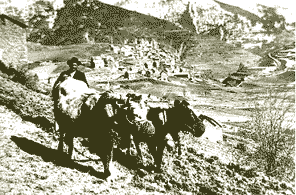
En bas du village, la Condamine (en latin campus domini ), lieu initialement réservé au seigneur pour ses tournois, fut un lieu idéal pour la culture du blé, des pommes de terre et des célèbres lentilles qui assurèrent la réputation de Beuil.
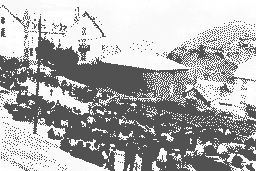
Elles étaient alors échangées contre des fruits qui ne pouvaient pousser à cette altitude, par exemple les figues de Rigaud, les pommes de Péone et les châtaignes de Roure, le troc étant alors la principale forme de commerce. En effet, l'argent ne fit vraiment son apparition à Beuil qu' au milieu du XXème siècle lorsque le gouvernement français instaura les allocations familiales.
L'église nous livre une autre partie de l'histoire du village. Dédiée actuellement à Saint Jean Baptiste et à la Vierge, elle était auparavant une simple chapelle du Rosaire, bâtie en 1687.
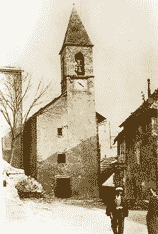
Elle fut consacrée conjointement aux deux saints après que l'église actuelle (alors simplement dédiée à Saint Jean Baptiste) fut brûlée par les habitants du village de peur que les troupes révolutionnaires ne l'occupent et y logent. Le bâtiment actuel imite le gothique tardif, mais son clocher, qui jouxte l'église, montre la persistance du style roman lombard du XVIème siècle.
Un peu au-dessus de la place de l'Eglise, sur son côté droit, se dresse la chapelle de la confrérie des Pénitents Blancs,
dédiée à Notre-Dame de la Miséricorde, restaurée en 1630.
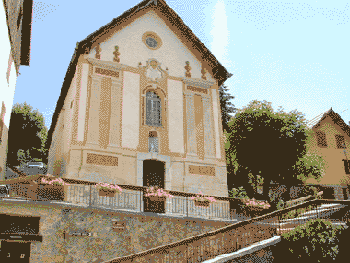
Au-dessus de la chapelle avait été ménagé un grenier, où les membres de la Confrérie, tous des laïcs, entreposaient en automne une partie des récoltes de céréales de façon à pouvoir les redistribuer à la sortie de l'hiver à ceux qui en avaient besoin, en particulier si l'hiver avait été particulièrement rude. Le décor en trompe l'œil de la façade a été restauré par le peintre Guy Ceppa en 1984.
Cette chapelle est inscrite au titre des monuments historiques.
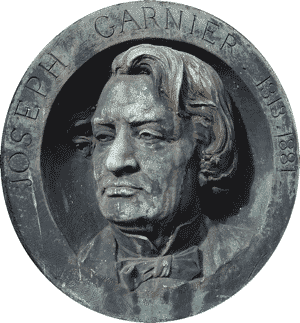
Joseph Garnier, économiste libéral
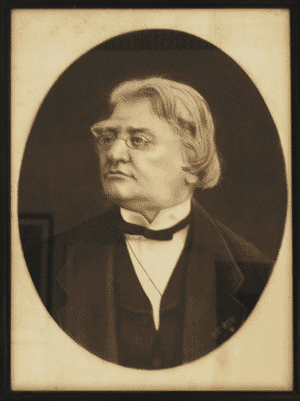
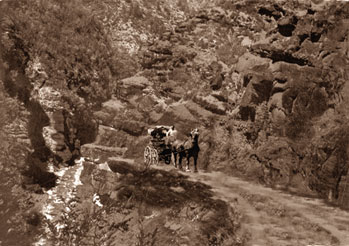
Théoricien du libéralisme, qui manifesta ses sympathies républicaines en 1830 pendant le soulèvement du peuple de Paris contre le Roi Charles X. Joseph Garnier lança le projet d'une route qui ferait se rejoindre Beuil et Nice par les Gorges du Cians. Celle-ci fut ouverte en 1893, facilitant le développement des sports d'hiver.
La rédaction régulière du journal populaire Le Jacques Bonhomme permet, à partir de 1848, de mettre en convergence des analyses économiques de Joseph Garnier et Gustave Molinari. Ce dernier, membre de l’Institut de France, définit ainsi l’objectif de leur collaboration : « Notre but était de faire concurrence aux utopies socialistes en leur opposant un programme de réformes économiques ».
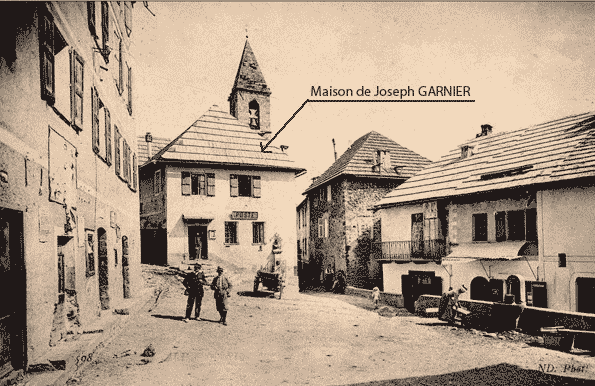
Né le 3 octobre 1813 à Beuil, Joseph Garnier est issu d’une famille de cultivateurs. Il sut garder toute sa vie cette sagesse terrienne qui explique l’ensemble de son œuvre. Entré à l'École Supérieure de Commerce de Paris, il y fut professeur et directeur des études.
Notons à ce sujet que l'École Supérieure de Commerce de Nice fut initialement créée par son frère Jean-Joseph Garnier.
La notoriété de Joseph Garnier a reposé principalement sur la chaire d’économie politique et de statistiques qu’il obtint en 1846 à l'École des Ponts et Chaussées. Il honore ce poste jusqu’à sa mort. Le très grand nombre d’articles et travaux met en évidence la richesse de ses analyses. Ses « Traité de Finances » et « Traité d ‘économie politique industrielle » ont été traduits en plusieurs langues.
Durant de longues années, il fut le rédacteur en chef du Journal des Économistes et après avoir participé à la création de la Société d’économie politique, il en fut le secrétaire durant 39 ans !
Son esprit profondément libéral explique son appartenance active à l'Association pour la liberté des échanges. Le 30 janvier 1876 il fut élu sénateur des Alpes Maritimes et mourut le 25 septembre 1881. http://www.appl-lachaise.net/appl/article.php3?id_article=2989
Un défenseur de la liberté d’entreprendre:
Joseph Garnier a été un disciple d’Adam Smith, de Jean-Baptiste Say, de Ricardo et de Malthus. Il annota l’Essai sur la population de ce dernier ce qui lui valut d’être qualifié de « malthusien » par les socialistes de l’époque.
Il fut un proche de Bastiat, le plus illustre champion du libre échange, et eut le mérite d’apporter une illustration très réaliste à l’œuvre des libéraux. Ses exemples sont très précis et touchent directement le citoyen dans la vie courante. Ainsi, en prenant l’exemple du pain, il a montré les effets pervers d’une taxe mal calculée; les coûts reposent sur des frais évolutifs que seul l’entrepreneur peut apprécier. De ce fait, les « prix officiels » constituent une erreur et reposent sur des informations erronées. Sa logique le pousse a mettre en évidence les effets pervers de certaines pratiques qui s’opposent aux libertés. L’institution de taxes, censées empêcher les monopoles, sont allées contre le but assigné. En effet, la taxation fait disparaître des unités de production et encourage les coalitions.
Ses origines terriennes le poussent à exprimer son attachement profond à la liberté de tous les cultivateurs qui, « loin de faire la famine, font l’abondance, lorsqu’on leur garantit suffisamment leur propriété ». Cette liberté permet à chacun de tenir compte des besoins exprimés par les consommateurs en fonction de leur spécificité et d’adapter le mieux possible les produits.
Certains passages constituent des analyses qui intéressent l’actualité du vingtième siècle. Elles aident à comprendre pourquoi face à des blocages et à des productivités catastrophiques, des pays qui ont nié le libéralisme économique retournent progressivement à l’exploitation privée des terres.
Dans son « Traité des Finances », il exprime sa préférence pour l’impôt sur le revenu et montre les difficultés rencontrées pour imposer un impôt sur le capital.
Les recherches faites sur le contribuable sont qualifiées d’« inquisitoriales » et de dangereuses. Elles font courir des risques aux industriels et aux commerçants « dont le crédit est si facile à atteindre… ».
Recherche d’un ordre naturel:
Jopseph Garnier est toujours considéré à Beuil comme un enfant du pays. Dans ce village, les habitants sont fiers de rappeler qu’il a offert sa maison près de l’église qui fut donc détruite pour permettre de dégager l’église et créer une place qui maintenant porte son nom. En définitive son don et sa générosité entrent bien dans la logique de son œuvre. La liberté individuelle implique un profond respect de la collectivité.
Son esprit de clarté se double d’un esprit de synthèse. Il va à l’essentiel. Ainsi, dans les « masses agitées » de la Bourse, dans ce « pêle-mêle », ce « vertige », il découvre un « ordre naturel » ; il montre qu’il s’agit d’un lieu où l’on constate des « prix courants », où l’on rencontre ceux avec qui l’on est en relations d’intérêt. Les Bourses sont de « véritables machines de l'industrie commerçante, simplifiant les démarches, multipliant les rapports (…) dans l’intérêt général de la production ».
Avec Bastiat, il pensait que « capitaliser, c’est préparer le vivre, le couvert, l’abri, le loisir, l’instruction, l’indépendance, la dignité pour les générations futures » et écrivait que « le capital est le thermomètre de l’état matériel et moral d’une société , d’un peuple ».
Le capital devient alors l’expression du progrès. A la campagne, grâce aux machines, les terres mieux cultivées sont plus productives et peuvent nourrir plus d’habitants ». Il en conclut alors que les machines « multiplient la population ».
On retrouve dans l’œuvre de Joseph Garnier la véritable raison des processus de capitalisation qui reposent essentiellement sur le travail et l’effort. Par le choix des mots, par le style simple mais agréable, on peut dire qu’il a été principalement un vulgarisateur. Disciple dans l’âme, il a su expliquer l’essentiel. Peut-être à cause de cela, à sa mort, dans le Journal des Économistes , Molinari écrivit : « Il s’était approprié les doctrines des maîtres de la science et il les défendait comme son propre bien ».
Cette épitaphe qui se voulait flatteuse explique cependant qu’à l’heure actuelle, Joseph Garnier n’a peut-être pas exactement la place qu’il mérite dans les bibliographies économiques.
S’il a divulgué en termes très simples des principes libéraux, il a eu aussi le mérite de les appliquer dans sa vie de tous les jours. Il faut peut-être y voir une des grandes forces de ces principes : ils sont applicables !
Article de Tony Tschaeglé, professeur à l’IUT de Nice, directeur du Centre d’économie marine au C.E.R.B.O.M.
Publié dans Nice-Matin le 29.10.1984
N’ayant pas réussi à contacter l’auteur de cet article malgré de nombreux efforts, nous le remercions par avance pour cette publication.
RETOUR AU SOMMAIRE
Une autre figure de l'histoire de Beuil est celle de Ferdinand Ferber (1862-1909). Polytechnicien à 20 ans, officier d'artillerie puis capitaine, nommé commandant de la batterie d'artillerie alpine à Nice, il compte parmi les pionniers de l'aviation française. Fasciné par le vol des machines plus lourdes que l'air, il s'intéresse aux travaux d'Otto Lilienthal. Conseillé par Octave Chanute, ingénieur français émigré aux Etats-Unis et consultant des Frères Wright, il construit plusieurs monoplans et biplans, empruntant aux Frères Wright le gouvernail de profondeur à l'avant de l'appareil, adaptant une queue fixe à l'arrière (que d'ailleurs les Frères Wright adopteront sept ou huit ans plus tard) et introduisant des traverses courbes dans le dispositif des ailes comme dans une aile d'oiseau. En 1901, il construit le Ferber V qui ne pesait que 50 kg pour une envergure de 9,50 m. et 33 m2 de surface. Son premier essai de vol a lieu à Beuil à partir d'une colline au-dessus de la Condamine le 24 Juin 1902.
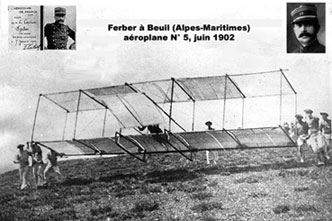
Il réussit à couvrir 25 mètres à la première tentative et 50 mètres à la seconde. Cet essai lui permettra, une fois son congé de l'armée accordé, de mettre au point d'autres appareils dans lesquels il introduit des moteurs à partir de 1905 pour résoudre le problème de la résistance de l'air qu'il avait mal évaluée au début de ses expériences. Il collabore dès lors avec l'ingénieur Levavasseur. En 1908, Ferber fonde la Ligue Nationale de l'Aviation. Malheureusement, en 1909, il s'écrase avec son avion au moment d'atterrir à Boulogne sur Mer. Il laisse plusieurs articles portant sur les travaux de Lilienthal et des Frères Wright et un ouvrage, L'Aviation, ses débuts et son développement , publié en 1908, dans lequel on trouve de nombreuses réflexions visionnaires.
RETOUR AU SOMMAIRE
Les Sports d'Hiver
Une date très importante dans l'histoire de Beuil fut 1910, lorsque le Chevalier de Cessole, personnalité haute en couleurs, pionnier en matière de ski, se déplaça à Beuil avec les skieurs des Chasseurs alpins et, grimpant au sommet de la Tête du Sapet et s'apercevant de l'immensité du domaine, décida d'en faire une station de sports d'hiver.
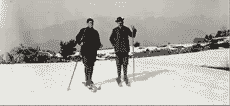
Jusqu'alors, seuls Peira Cava, choisi par le Club Alpin Français pour sa proximité de Nice et pour ses hôtels, et Thorenc, choisi par le Touring Club de France pour ses installations, ses activités sportives et son lac, recevaient des skieurs. 1910 fut l'année du lancement du premier ski-club des Alpes Maritimes, qui organisa à Beuil le 28 Mars de cette année-là, la première compétition, présidée par le Chevalier de Cessole. Il était arrivé quelques jours plus tôt, accompagné de nombreuses personnes qui avaient pris le train jusque Pont de Cians et de là, des voitures tirées par des chevaux les amenaient à Beuil. La plupart séjournaient à l'Hôtel Millou et dans les cinq autres hôtels dont Beuil s'était doté entre 1861 et 1892. Le 28 Mars 1910, donc, de nombreuses compétitions eurent lieu, ski de fond, saut, course d'obstacles avec des tonneaux et des seaux pleins d'eau à ne pas renverser…
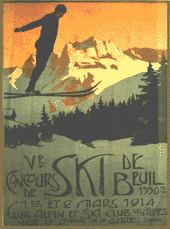
Jusque 1914, la réputation de ces manifestations ne cessa de grandir. Elles reprirent en 1920 après la guerre. En 1923, plus de 1500 personnes étaient présentes pour voir 60 compétiteurs.
Film amateur muet, 8 mm.
Scènes de vie dans la station de sports d'hiver de Beuil dans les Alpes-Maritimes. Décennie 1930.
Réalisé par Félix Hancy :
Les sports d’hiver sur la Côte d’Azur, 1930 -... par archivesdepartementCG06
En 1924, le Club de Sports d'Hiver de Beuil fut créé et en 1930 un tremplin fut inauguré dans la Condamine en présence de champions internationaux, dont Emil Petersen, champion olympique, et le Lieutenant Pourchier, originaire de Beuil, membre de l'équipe olympique française, initiateur du tremplin. La toute jeune Ecole de Ski de la Côte d'Azur commença à organiser des leçons et des entraînements en 1933, comptant jusqu'à 300 membres l'année suivante.
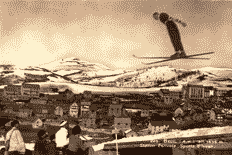
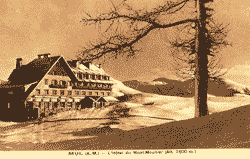
Le 6 Janvier 1930, Beuil connut une belle heure de gloire avec l'inauguration de l'Hôtel du Mont Mounier, dans le quartier des Launes, dont l'idée revenait à Edouard Baudoin, le promoteur du Palais de la Méditerranée à Nice. Il s'agissait d'un hôtel de grand luxe avec salles de bains attenant à chaque chambre, comprenant 40 employés et 25 aides-cuisiniers. Parmi d'autres célébrités, on voyait fréquemment la Princesse Aga Khan, le Comte de Béarn, la Comtesse Orsini et le Prince Obolenski.
En 1935, la construction du Grand Hôtel à Valberg et l'installation de la première remontée mécanique de la région sur la piste nord de la Croix du Sapet assurèrent le développement rapide de Valberg.
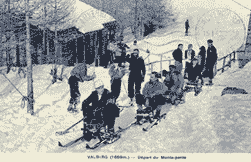
En Février 1937, Beuil inaugura son propre tremplin olympique, le seul de toutes les Alpes du Sud, ainsi qu'un remonte-pente dans le quartier des Launes, entièrement financés par le village.
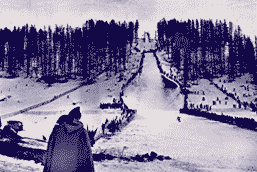
Le champion norvégien Kaarly ouvrit la compétition. En 1938, 15 000 personnes assistèrent aux championnats de saut et la même année, le célèbre explorateur Paul Emile Victor eut l'idée de traverser les Alpes du Sud au Nord, partant de Beuil pour arriver à Chamonix en traîneaux à chiens.
Pendant la deuxième guerre mondiale, Beuil se distingua en sauvant et en cachant un groupe d'Israëlites traqués par les troupes nazies.
Il ressort de cette longue histoire que Beuil est inséparable d'un esprit d'indépendance, d'entreprise, un esprit de défi, ainsi que d'une certaine fierté de posséder un passé de lutte, d'où une volonté forte d'affirmer son identité. C'est sans aucun doute cette caractéristique qui explique l'attachement que l'on éprouve lorsque l'on se promène dans ses ruelles sinueuses et que l'on échange quelques mots avec les habitants. C'est cet esprit de résistance montagnarde, et son charme subtil, que tout visiteur ne peut que ressentir et apprécier.
Bibliographie sommaire :
Le Village de Beuil , édité par Le Mercantour, collection Cairns (1991) : 8 pp.
Association Lou Savel, Ici Finit le Comté de Beuil, inventaire des archives dans les villages du Comté de Beuil 3 ans après l'éxécution d'Annibal Grimaldi, d'après un manuscrit inédit de 1624 , Nice, Editions Serre (1987) :132pp.
Jean-Pierre Lombard, L'Histoire du Ski dans les Alpes Maritimes , Nice, Editions Giletta (1985)
RETOUR AU SOMMAIRE
L'observatoire du Mont Mounier
Au début des années 1890, le député de Nice, Raphaël Bischoffsheim, mécène et féru d'astronomie, fondateur de l'Observatoire de Nice, se met en quête d'un lieu où installer une annexe de l'Observatoire de Nice afin de développer les connaissances météorologiques et astronomiques de la région à partir d'un endroit qui échappe à l'atmosphère impure des villes.
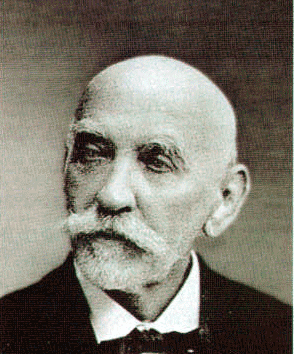
Raphaël Bischoffsheim
Après avoir considéré trois sites possibles, le Tournairet, l'Authion et le Mont Mounier, c'est ce dernier qui est choisi par le bureau des
longitudes, en accord avec le Colonel Bassot, membre de l'Institut et le Commandant Deffoges, tous deux attachés au service géographique de l'armée. A 2760 m. d'altitude, l'observatoire se place au troisième rang en altitude dans la région, après le Mont Blanc et le Pic du Midi.
Dès 1890, la notoriété du lieu s'accroissait. Le mont Mounier était la cime la plus visitée du département. Entre août 1895 et avril 1896,
123 personnes s'y étaient rendues, en 1902 on a enregistré 276 personnes, dont 154 militaires. Pour aider à ce développement, deux
guides muletiers, Michel Pourchier et Ambroise Robion, furent nommés à Beuil par le Club Alpin Français. Le Chevalier de Cessole envisagea même d'y créer un chalet-hôtel offrant calme, silence et panorama sublime. Il avait aussi pensé à y installer une petite pharmacie et une carte plane pour renseigner les visiteurs sur le panorama.
Le Mont Mounier.
Culminant à 2817 mètres d'altitude, il se situe entre les vallées du Var et du Cians, dominant , entre autres, les Gorges du Cians. Datant du
crétacé inférieur, il a toujours frappé les imaginations par sa majesté, tour à tour appelé " le lion", "la cathédrale gothique" ou "le roi".
Entouré du Mont Démant, du lou Sadour, du Galestinero, du Coulomet, de l'Adré et de l'Estrop comme autant de sujets, il présente plusieurs intérêts, géologique, géodésique, botanique, astronomique, météorologique et historique. Très giboyeux, du moins au dix-neuvième
siècle, il est connu pour sa flore riche et variée.
L'origine de son nom est simple: devant être orthographié " Monnier", il vient de "Mons niger", la montagne noire, ce nom provenant du calcaire bleu noir qui le constitue. Sur une ancienne carte, on lit "Mont Niert" et c'est le Chevalier Victor de Cessole qui l'orthographie le premier Mont Mounier, à moins qu'il s'agisse alors d'une confusion facile à faire, entre "n" et "u" au moment d'imprimer le nom.
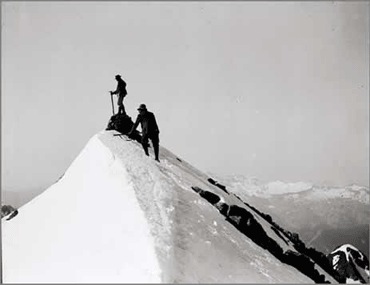
Le premier à escalader plusieurs fois jusqu'au sommet, du moins à ce que l'on sait, est le naturaliste niçois Risso. Selon Risso, en 1820, le
pic du Mont Mounier s'écroula avec fracas et cela lui donna son altitude actuelle. En 1858, Joseph Garnier, l'économiste natif de Beuil, y monta avec un autre Beuillois, Maurice Pourchier, propriétaire de la montagne. Ils y déposèrent leurs cartes de visite sous une pierre au bas d'une colonne installée par l'armée. Le Mont Mounier était effectivement un lieu utilisé par les militaires comme poste d'observation et terrain de
manoeuvres.
En 1868, Maurice Pourchier vend le Mont Mounier à la commune de Roubion pour 60 000 francs, payés par moitié en argent et par moitié en bois.
En 1888, l'avocat et naturaliste niçois Antoine Risso récolte sur ses pentes une trentaine de plantes médicinales, dont le célèbre génépi.
En 1892, le Chevalier de Cessole monte depuis Beuil, guidé par l'aubergiste Pourchier par le Col de Moulinès puis par le Mont Démant.
Ils y parviennent en trois heures. Cessole ne tarit pas d'éloges sur le Mont Mounier, stupéfié par le spectacle grandiose qui s'offre à ses yeux, semblable au soleil de minuit, le fameux "phénomène spectral" qui se produit dans la première quinzaine de février: depuis la petite cîme, au moment du lever du soleil, on voit la pointe du sommet dessiner dans les airs à plusieurs kilomètres une magnifique pyramide et pendant une demi-heure les contours du spectre lumineux, d'abord vivement colorés de vert et de bleu, passent par d'autres couleurs. Peu à peu cette grande ombre s'efface devant l'apparition de l'astre solaire. Cessole reviendra sur les lieux plusieurs fois.
Le 26 mai 1894, la commune de Roubion cède 14 000 m2 du Mounier au député Bischoffsheim chez Maître Trophime Ciaudo, notaire à
Saint-Sauveur. Mais ce qui a fait la notoriété du Mont Mounier, c'est surtout l'Observatoire dont l'histoire est parsemée de péripéties multiples.
La Construction de l'Observatoire.
Le site initial se composait de trois bâtiments:
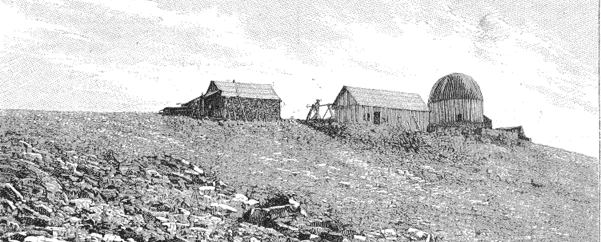
Un entrepreneur de Roubion, Monsieur Maynard, est choisi pour les constructions en bois et il est bientôt félicité pour sa rapidité et la qualité de son travail. Le tout doit être démontable et préalablement essayé au bas du Mounier ou à l'Observatoire de Nice. Chaque pièce ne devra pas peser plus de 100kg.
L'administration de l'Observatoire privilégia l'acheminement des matériaux depuis Beuil et créa pour cela un nouveau sentier, plus large et plus aisé. Les travaux furent terminés fin 1893.
Deux baraquements rectangulaires sont prévus. L'un de 10 m. sur 4, haut de 3 m, à usage d'habitation, doté d'une double paroi garnie de varech pour l'isolation, l'autre de 5m sur 3, haut de 2 m., qui servira d'entrepôt pour le matériel et comme abri pour les mulets. Une galerie
de 4m. de long reliera la maison d'habitation à la coupole et un atelier de forge sera construit pour les ouvriers. Enfin une citerne de 49 m3 sera creusée dans le rocher à l'ouest de la maison pour recueillir les eaux de pluie et de la fonte des neiges.
Une lunette de 7m. de focale et de 0,38 m. d'ouverture (grossissements: 140-190 et 270) avec mouvement d'horlogerie et rappel en ascension droite et en déclinaison sera installée dans la coupole sphérique de 8 m. de diamètre, mobile sur un chemin de fer, à la partie supérieure du bâti en bois de 4 m. de haut et de 8m. de diamètre.
La lunette et son pied, ainsi que la coupole seront construits à Paris par Gautier. La Direction de l'Observatoire de Nice possédait déjà la
partie optique de la lunette. L'équatorial portait un micromètre à fil de platine avec vis micrométrique.
En août 1892, le charpentage du premier bâtiment et la première fenêtre destinée aux observations astronomiques sont réalisés.
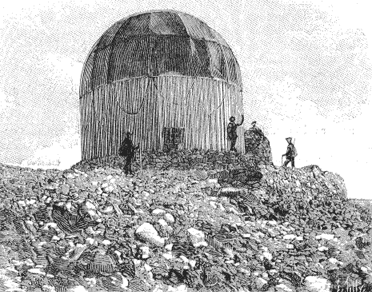
Tour cylindrique pour l'équatorial de l'observatoire du mont Mounier
A la fin de l'été 1893, l'ensemble est installé. Mais le mercredi 13 décembre 1893, alors que les astronomes Perrotin,
directeur de l'Observatoire de Nice, et Prin, astronome, ainsi que les Frères Maynard sont occupés à compléter l'installation à l'intérieur de la coupole, le feu prend dans le bâtiment d'habitation à partir du poële à charbon. Le tuyau avait mis le feu aux boiseries et la maison brûle
entièrement. Des pièces d'or et d'argent seront d'ailleurs retrouvées, fondues, preuve de l'intensité du feu. Ne pouvant rester sur place, les quatre hommes redescendent à Beuil avec difficulté à cause de la neige qui est tombée en abondance. Un peu plus tard, l'objectif et le micromètre (ou magnétomètre) à fil de platine seront transportés à Beuil et Nice.
Le deuxième Observatoire.
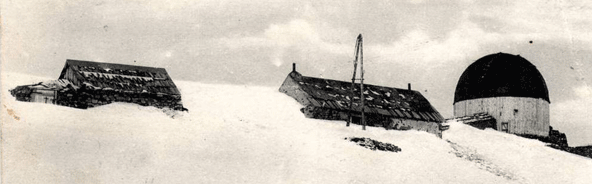
L'année suivante, 1894, Raphaël Bischoffsheim fait reconstruire sur l'emplacement de l'ancienne habitation une nouvelle maison en maçonnerie de quatre chambres. Pour aller à la coupole une galerie de 29,80 m. est aménagée en pierres sèches, recouverte d'une chape de ciment, éclairée par plusieurs lucarnes, avec une couche de 20 cm. de terre pour protéger de la neige et des fortes gelées. (La longueur du tunnel, on le voit, reste un mystère: erreur ou s'agit-il d'un autre bâtiment).
La coupole en toile goudronnée, qui avait été sérieusement endommagée, est remplacée par une couverture en tôle galvanisée. Un quatrième bâtiment est construit pour y travailler à l'abri, c'est la forge prévue précédemment.
Le 14 juillet 1894, un coup de foudre tue le chien de M.Maynard sur le pas de sa porte et blesse deux maçons non loin de là
Le téléphone est mis en place du 2 au 7 septembre 1895 entre l'Observatoire et Beuil. Les 8 km de fils et les poteaux qui suivent le sentier servent aussi à se repérer l'hiver et, bien sûr, transmettent les liaisons par télégraphe entre Beuil et l'Observatoire de Nice,
transmises ensuite entre l'Observatoire de Nice et Paris. Les observations météorologiques sont réalisées chaque jour par M.Maynard qui devait rester sur place pour surveiller les habitations et transmettre ses constatations.
L'inauguration officielle de l'Observatoire a lieu le 19 août 1895.
Les observations.
Les premiers travaux sont réalisés par M.Perrotin en août 1895. Ils concernent l'observation de la planète Vénus avant son passage dans sa
conjonction inférieure. Le 2 et le 30 août, il peut voir la surface du disque de la planète avec de beaux détails et ces observations sont poursuivies avec succès les premiers jours du mois de décembre suivant et en février 1896. Les résultats obtenus par M.Perrotin sur la durée de la rotation de Vénus font l'objet de sa part de deux importantes communications à l'Académie des Sciences dans les séances du 21 octobre 1895 et du 24 janvier 1896 (tomes CXXI et CXXII des comptes-rendus de l'Académie des Sciences).
Grâce à ces observations, on a obtenu la certitude que la durée de révolution de Vénus autour du soleil était exactement égale à sa
rotation sur elle-même. Mais la découverte la plus importante fut celle de Perrotin des protubérances à la surface de la planète et de sa partie obscure qui lui confère sa couleur cendrée si particulière.
C'est aussi à l'Observatoire du Mont Mounier qu'a été mise en évidence la présence de vapeur d'eau sur Mars, mais cela semble être une erreur, ou une inversion des noms de Vénus et Mars.
Tout cela a amené les scientifiques niçois à attacher énormément de prix à cet observatoire dont les observations et les moyens techniques
s'ajoutaient à ceux de l'Obsevatoire du Mont Gros à Nice.
Les relevés météorologiques parurent dès mars 1897 dans la Revue Alpine, publiée apr le Club Alpin Français.
Le Mont Mounier était un lieu particulièrement privilégié pour l'étude des orages. Les propriétés spécifiques des conditions d'observation
étaient remarquables et les descriptions mêlaient science et poésie en un émerveillement total. Bref, l'Observatoire du Mont Mounier devint le complément parfait de l'Observatoire de Nice.
Joséphin Maynard, le gardien du lieu et responsable des observations transmettait les températures à Nice à 7 heures du matin et à 18 heures, relayées par Beuil, et c'est ainsi que Beuil devint célèbre dans les milieux scientifiques dès juillet 1896. Maynard resta à l'Observatoire 25 ans, ce qui est un véritable exploit, et on peut estimer qu'il lui a fallu une persévérance et une ténacité à toute épreuve. Pour accéder au site, il fallait environ 3 heures de marche, 4 heures depuis Péone et 6 heures depuis Saint-Sauveur. Il accueillait les visiteurs - des centaines de randonneurs s'y sont arrêtés toutes ces années-là - et leur mitonnait des repas réputés copieux (soupe de riz au lard et aux choux !) avec l'aide de sa femme Sophie et de sa fille Clémence. On chauffait le lieu avec de la tourbe grossière qu'on extrayait à côté de la coupole. Elle brûlait, mélangée à du bois ou à du charbon de terre.
De nombreuses souches d'arbres restaient tout autour depuis qu'en 1624, le Duc de Savoie avait presque complètement déboisé le site afin de construire de trs nombreux navires à Nice et à Villefranche. La compétence de Maynard était reconnue par tous. Ses relevés météorologiques étaient publiés dans les principaux journaux et revues scientifiques en France. N'oublions pas qu'à cette époque, la météorologie était une science naissante. Quand il redescendait à Beuil où il habitait (dans la petite impasse qui descend en face de l'école), il prenait des photos qu'il faisait imprimer en cartes postales et vendait à son refuge. Il devint président du Syndicat d'Initiative de Beuil et fut la cheville ouvrière du développement du tourisme montagnard de la région. Le 5 août 1910, il fut décoré des Palmes Académiques. Il mourut en 1919 et on donna son nom à une variété de mollusques terrestres qui vivent sous les pierres calcaires du Mounier et du Démant sous la neige des parties non ensoleillées, l'Helix Coelata Maynardi.
Fin de l'exploitation.
A la mort de Raphaël Bischoffsheim en 1906, l'Observatoire devint propriété de l'Université de Paris. Le 31 juillet 1910, un incendie détruisit la coupole. Toute activité cessa le 31 décembre 1918. Le matériel astronomique fut récupéré et la lunette fut transportée à l'Observatoire du Pic de Midi. Les bâtiments furent abandonnés en 1927, année où l'habitation fut louée par le Club Alin Français pour être transformée en refuge, inauguré le 15 juillet 1928.
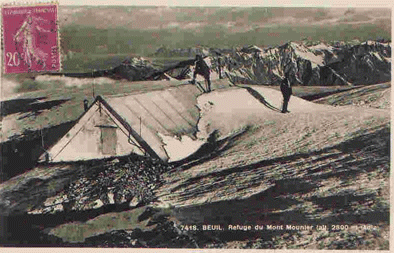
Le refuge du C.A.F.
En 1938, le gérant du refuge fit restaurer la citerne, sceller des barreaux pour descendre au fond et installer une petite poulie à l'intérieur. Non entretenu, le bâtiment se dégrada peu à peu pour devenir une ruine.
Nous sommes redevables pour tous ces commentaires et remarques à M.Gilbert Boulay de Contes et surtout à Michel Fulconis, professeur de langue d'Oc au Collège St Blaise de Saint-Saveur, spécialiste du patrimoine du Haut-Pays niçois. Son article intitulé "Le mont Mounier et son observatoire", publié dans Amont, Association Montagne et Patrimoine, dédié à Hermione Guibert (descendante de la famille de Joseph Maynard) a inspiré l'essentiel de cet article. Qu'ils en soient tous remerciés ici.
http://amontcev.free.fr/mont%20mounier_.htm
NOTE ANNEXE : Le Député Louis-Raphaël Bischoffsheim.
Raphaël-Louis bischoffscheim est né à Amsterdam le 22 juillet 1823 et mort à Paris le 20 mai 1906. Il était banquier, homme politique et mécène fondateur de l'Observatoire de Nice.
Naturalisé français en 180, député des Alpes maritimes de 1881 à 1885 (pour Nice-campagne), de 1889 à 1890 (pour Nice-ville) et de 1893 à 1906 (pour Puget-Théniers), il est membre de l'Union Républicaine (soit centre gauche ou socialiste actuellement), soutenant les ministères de Jules Ferry et Léon Gambetta.
Fasciné par l'astronomie, il a financé l'Observatoire de Paris, l'Observatoire du Parc Montsouris et celui du Pic du Midi. Il est élu
membre libre de l'Académie des Sciences en 1890.
(Voir Michel Fulconis, Raphël Bischoffsheim, l'homme qui a offert à la France le plus grand observatoire du monde, Editions Regards du Monde, 2003.)
RETOUR AU SOMMAIRE
.gif)
ACCIDENT "HISTORIQUE" : FEVRIER 1939
fait divers de politique européenne à la veille de la Deuxième Guerre Mondiale
Le 24 février 1939, à 7 heures 45 du matin, un avion non-identifié survole la zone interdite au-dessus de Roure et de Saint Sauveur dans la direction de Beuil vers le nord-ouest, par temps bas, très nuageux et pluvieux, la pluie se transformant en neige en altitude. D'après le bruit du moteur entendu par plusieurs agriculteurs, l'appareil volait à environ 700 mètres d'altitude. Selon les témoignages, le bruit de l'avion cesse brutalement, laissant penser à une chute sur les pentes de la montagne de Tizène. Entre-temps, le service radio d’Antibes capte deux appels radio de l’avion demandant à Gênes le relevé de sa position et plusieurs navires entendent des SOS, mais sans autre message particulier.
Des renseignements supplémentaires émanant du chef de la compagnie du 141ème R.I.A. en garnison à Beuil font état de détonations entendues le même jour à Beuil à 8 heures du matin. La gendarmerie de Saint Sauveur se met en route mais doit rebrousser chemin, l'épaisseur de neige atteignant plus d'1 m.50. D’autres patrouilles sont organisées, mais sans résultat et ce n'est que le 4 mars au matin que des éclaireurs du141 ème R.I.A. (Régiment d’Infanterie Alpine), sous les ordres du Chef de Bataillon Vautrin, du 9ème bataillon de Chasseurs Alpins d'Antibes, découvrent un appareil allemand écrasé au col de Terme-Ribi.
Dix cadavres (un télégramme de la gendarmerie cite onze cadavres) sont localisés dans et autour de l'appareil avec de nombreux documents et objets.Toutes les autorités militaires d'Antibes, de Toulon et de Nice sont alertées.
Une colonne constituée de militaires du 74ème B.A.F. (Bataillon d'Artillerie de Forteresse) du Fort de Rimplas, de la brigade de Guillaumes, de deux médecins auxiliaires, les docteurs Guérin et Tasso, et de quelques douaniers de Saint Sauveur, se rend à Roubion dès 5 heures du matin puis jusqu'au Col de Terme-Ribi malgré une couche de neige de plus de 2 mètres. Arrivés sur place vers 7 heures 30, au lieu-dit Terme-Ribi, à 100 m. environ au sud-est du col au point de rencontre des sentiers venant du hameau désert de Villars, ils établissent les constatations d'usage.
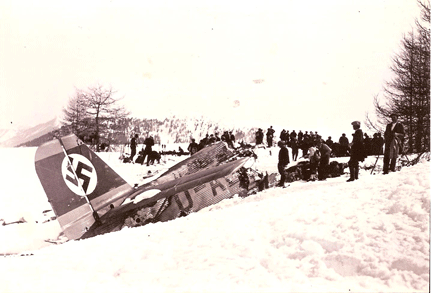
L'appareil était un trimoteur allemand du type Junker D-A.L.U.S (type JU 52 – F.9X). Il avait commencé à toucher le sol à 74 m. de son point de chute final, avait rebondi 15 m plus loin à 3 m du sol et avait perdu son train d'atterrissage. Après avoir décapité 3 mélèzes, il avait, 12 m. plus loin, fauché 3 autres mélèzes à 2 m. du sol, puis 10 m. plus loin un autre mélèze de 25 cm de diamètre, perdant un de ses moteurs dans sa course folle. Après avoir perdu le deuxième moteur, il s'enfonce dans la neige 20 m. plus loin, hélice d'abord. L'amas de ferraille est inextricable. La carlingue est détruite par le feu qui avait pris dans les réservoirs. Dix corps carbonisés enchevêtrés sont découverts à la place qu’ils occupaient vraisemblablement dans l’avion, sauf un projeté à quelques mètres de là, et le rapport de gendarmerie mentionne la découverte d'une centaine d'oranges dans le fuselage.
Sur le gouvernail, se trouve une croix gammée noire sur fond rouge et blanc; de nombreuses inscriptions techniques sont relevées (dont Junker JU 52 – 3 M) ainsi que ce qui reste des passeports des occupants et de leurs divers objets. Sont récupérés des liasses de billets de pesetas espagnoles, des disques de phonographe, deux plaques d'identité aux noms de Willi Schinks et Uhl Walter, un fusil, un appareil photo, des bagues, des chevalières, des montres et un insigne de la croix gammée.
A noter également un gobelet en métal sur lequel est inscrit: "Legion Condor S.88 36-38".
Par ailleurs, de nombreuses lettres non timbrées et autres documents sont rassemblés par le Sergent-chef Chaix du 141ème R.I.A. de Beuil qui empaquette l'ensemble en 13 paquets qui sont remis au Commissaire Divisionnaire de la Police de l'Air à Nice le 7 mars.
Le lendemain, le 5 Mars, l’attaché consulaire d’Allemagne, M.Lierau, arrive sur les lieux avec des linceuls. Le Commandant Descours, responsable du rapport de gendarmerie, refuse de lui remettre objets et documents trouvés dans l’appareil.
La route de Roubion à Saint Sauveur ayant été coupée par la neige, les corps (non identifiables) sont transportés à Beuil sur des traîneaux et des brancards et déposés dans la Chapelle des Pénitents Blancs aménagée par la municipalité, le Docteur Donadey étant maire et l’Abbé Nicol curé de la paroisse. Le lendemain, accord est donné par l’Ambassade d’Allemagne, le Préfet des Alpes Maritimes et Jean Médecin, maire de Nice, de transporter les corps de Beuil au reposoir du Château à Nice. Ce qui fut fait après qu’un régiment du 141ème R.I.A. sous les ordres du Capitaine Vincenti eut rendu les honneurs.
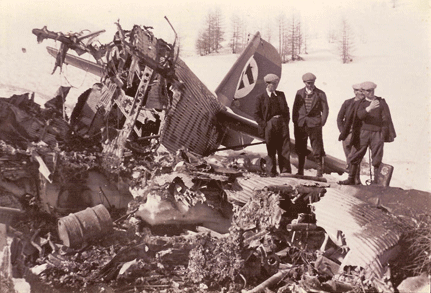
Les objets retrouvés.
Outre les objets ci-dessus nommés, ont été trouvés des appareils photo Retina et Leica, 3 masques à gaz de marque Trager, un pistolet automatique 7,65 mm, un insigne officiel de la Luftwaffe, deux plaques métalliques sur laquelle on pouvait lire « Vernichtung des Feindes von Spanien» (« Anéantissement des ennemis de l’Espagne») 1936-37-38, 3 gobelets, en tout, portant l’inscription « Legion Condor –L.C.88 », une chevalière avec les initiales L.C.88, une autre avec le faisceau italien, symbole des Fascistes de Mussolini, des clefs et une valise contenant un volumineux dossier concernant des groupements d’aide aux réfugiés israélites, comprenant de la correspondance avec le Comité d’Aide à l’Enfance Israélite à paris et des notices individuelles et des certificats médicaux.
Identification des corps.
Grâce à ce qui reste des passeports et à plusieurs recherches, les corps sont identifiés le 9 mars au reposoir du Château à Nice. Sont ainsi identifiés par l’attaché consulaire d’Allemagne : le pilote Lothar Lessman de Berlin, un officier Uhl Walter de Berlin, Hermann Grunewald, co-pilote, un passager Erich Regenhardt de Magdebourg, Paul Timmier de Tilsitt, le Lieutenant Oscar Berti, ressortissant italien commandant une escadrille légionnaire à Palma, un officier de la Légion Condor, Willem Bodden, un autre Werner Kubenik de Breslau, un officier militaire nazi Michel Hagel de Pfaffenhoffen en Bavière, un sous-officier et mécanicien Willi Wohlecke. Un reste de passeport livre aussi le nom de Willi Schinks retrouvé dans la cabine à côté des appareils de bord. Dix ou onze corps ? Cela, nous pensons, importe peu.
La suite des événements.
Le 8 mars la délégation allemande, venant de Stuttgart arrive à Nice à 14 heures 30 et identifie les victimes pendant quatre heures. Le vice-consul d’Italie est aussi présent pour identifier le corps de l’officier italien.
Le 9 mars, la délégation technique franco-allemande se rend à Beuil. A 10 heures 30, à Nice, un office religieux est célébré devant de nombreuses couronnes , celle du maréchal Goering, ministre de l’Air du Reich et celles de diverses autorités de l’aviation allemande. Une allocution remercie les autorités françaises et les villages de Roubion et de Beuil.
Le 10 mars, un office religieux est célébré pour l’officier italien.
Le 13 mars, les cercueils partent pour l’Allemagne.
Explications, remarques.
L’avion assurait chaque semaine la liaison entre Berlin, Rome, Gênes, le Baléares et Barcelone, aller et retour pour des sujets allemands et italiens. Un des passagers avait d’ailleurs sur lui une facture de l’hôtel Inglese à Palma de Majorque, où il avait fait un séjour les 22, 23 et 24 février. Il semble donc évident que le survol de la zone interdite n’était PAS délibéré, par exemple à des fins d’espionnage. Les conditions atmosphériques très défavorables et l’absence de visibilité sont clairement les causes de l’accident. Une avarie sur les instruments de navigation en est probablement à l’origine, si l’on pense aux nombreuses demandes de position enregistrées par la station de Gênes (survolant une zone interdite, l’avion ne pouvait pas s’adresser à une station française) – ou alors un défaut dans le système de dégivrage.
L’avion (immatriculé D-A.L.U.S. : Delta Alpha Lima Uniforme Siera) appartenait à l’Etat, plus précisément au Reichs Luftahrt Ministerium, la croix gammée sur le gouvernail en attestant.
La valise qui contenait des documents français concernant des Israélites dans un tel avion indique clairement l’intérêt que ces personnes représentaient pour l’Allemagne. Comment sont-ils arrivés là ? Il s’agissait d’une association qui facilitait l’émigration des Israélites, Hicem Hias Jca Emigration Association, sise 2 avenue de Messine à Paris, puis 89 Boulevard Hausmann à partir de 1941.
Petits rappels historiques :
La liaison qu’assurait l’appareil évoque bien évidemment l’alliance tripartite des trois dictateurs, Hitler, Mussolini et Franco. Rappelons qu’en mars 1939, la République espagnole agonisait sous les attaques des « nationalistes « du Général Franco. Barcelone était tombée le 26 janvier 1939 et Madrid allait tomber le 26 mars.
La Légion Condor était l'escadrille que Hitler avait mise au service du Général Franco. C’est la Légion Condor qui a été responsable du massacre de Guernica le 26 avril 1937. Cette atroce mission militaire conjointement allemande et italienne (16 appareils allemands et 8 italiens) fut l’une des premières où les Junker JU-52, à l’origine avions de transport civils, furent testés en tant qu’appareils militaires capables de transporter 1500 kg de bombes. (Sur l’un des gobelets, la lettre S.88 renvoyait au grade de Commandant en chef de l’Etat Major et des Services administratifs. Sur les autres insignes marqués L.C., la date 36 indique l’année de la création de la Légion et 38 sa dernière réorganisation).
Tous ces éléments ont été rassemblés à partir du rapport de la gendarmerie du 5 mars 1939 et de la reconstitution, remarquable dans son détail et son souci d’exactitude, élaborée par Monsieur Gilbert Boulay. Qu’il trouve ici l’expression de tous nos plus vifs remerciements pour nous avoir autorisé à reprendre la plupart de ses propres commentaires.
RETOUR AU SOMMAIRE

 THE HISTORY OF BEUIL